Crypto scalping strategy for beginners: a simple daily routine
A good crypto scalping strategy for beginners is simple enough to follow when you are nervous. So it uses one timeframe, one clear signal, and the same risk on every trade.
So this guide gives you that routine step by step. It also lists the traps that hurt new scalpers most, so you can avoid them from day one.
- Start with one timeframe, one or two coins and a clean chart.
- Risk the same small amount on every trade, and stop after two losses.
- Enter only fresh signals that agree with the higher timeframe.
- Finally, write down every trade, because the log is where you improve.
What scalping really is
Scalping means taking small, quick trades that last minutes, not days. Also, each trade aims for a small move. As a result, you take more trades, and fees and discipline matter more.
However, many beginners think scalping means trading all day. In fact, the best scalpers often take just a few trades. Instead, they wait for clean setups and skip the rest.
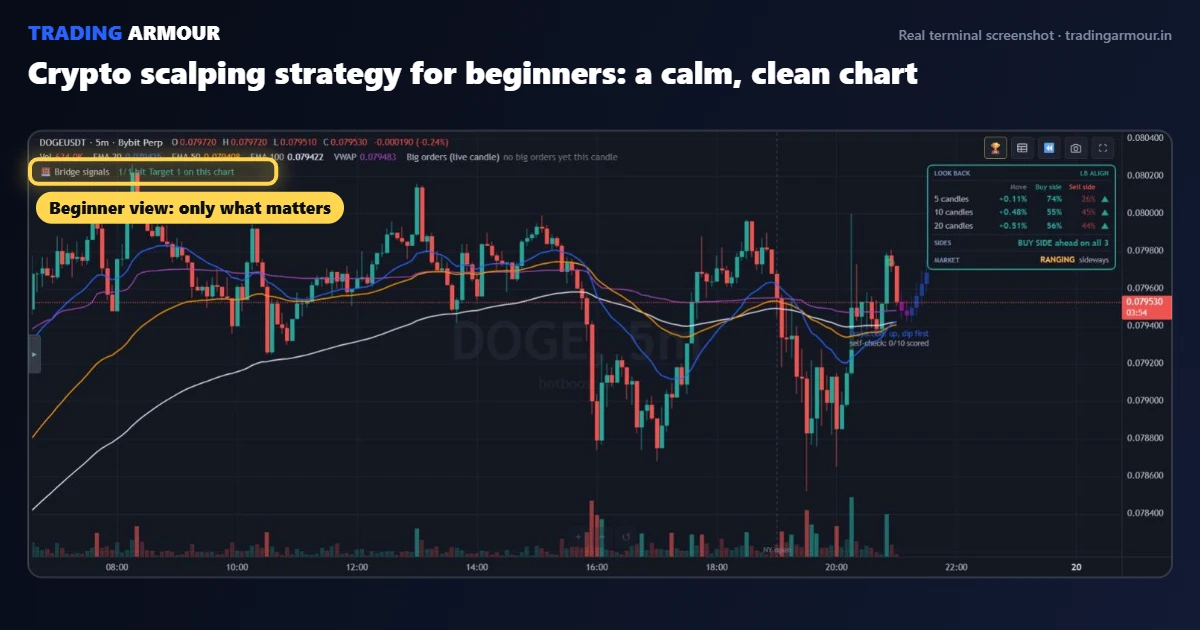
Set up a clean chart
After all, a busy chart leads to busy decisions. So start with the Beginner view in Trading Armour. This view shows only candles, volume, moving averages, VWAP and the buy and sell signals.
- Timeframe: the 5 minute chart. It is calmer than the 1 minute chart.
- Coins: one or two busy coins, such as BTC or ETH.
- Higher timeframe: keep a 1 hour chart open to see the trend.
Later, you can add order flow and scanners. At first, however, fewer tools mean clearer choices.
The crypto scalping strategy for beginners, step by step
- Check the 1 hour trend. Only take BUY signals when it points up, and SELL signals when it points down.
- Wait for a fresh closed-candle signal on the 5 minute chart.
- Next, check the AI verdict. If it says AVOID, skip the trade.
- Size the trade so the stop loss costs a fixed amount, such as 1% of the account.
- Then enter, with the stop placed on the exchange right away.
- At Target 1, close half and move the stop to entry.
- Finally, let the rest run to Target 2 or the trailing stop.
In short, that is the whole crypto scalping strategy for beginners. Because every step is fixed, you have fewer choices to make under pressure.
Trading Armour draws the entry, stop loss and two take profit targets on every signal. Also, it runs in your browser for Bybit and Binance futures.
Daily rules that keep you in the game
| Rule | Why it matters |
|---|---|
| Stop after 2 losses | Stops revenge trading |
| Same risk every trade | One loss never hurts much |
| No trades in the first minutes after big news | Spreads and wicks are wild |
| Log every trade | Shows what actually works |
At first, these rules feel slow. Still, they are what keep a new account alive long enough to learn. In addition, our crypto scalping risk management guide explains them in more depth.
Crypto scalping strategy for beginners: common traps
- Chasing: entering after price already ran. Instead, wait for the next setup.
- Moving the stop: widening it to avoid a loss. Then one loss becomes three.
- High leverage: it does not raise your edge; it only brings liquidation closer.
- Too many coins: you miss your own rules while flipping charts.
Also, avoid stops at obvious lows, because they get swept. Our guide to stop loss hunting shows better places.
What to learn next
Then, once the routine feels easy, add one tool at a time. For example, turn on the AI crypto signal scanner so setups come to you. Then learn to read big orders with the order flow guide.
Meanwhile, keep the glossary close. Also, our crypto scalping glossary explains every term in plain English.
Crypto scalping strategy for beginners FAQ
How much money do I need to start scalping?
Start with an amount you can afford to lose completely. A small account is fine, because the rules are the same and the lessons are cheaper.
What is the best timeframe for a beginner?
The 5 minute chart, with the 1 hour chart for the trend. It gives fewer, calmer signals than the 1 minute chart.
How many trades should I take per day?
Only the clean ones. For many beginners that is two to four trades, and stopping after two losses.
- Scalping risk managementSeven plain rules, because risk control keeps a scalping account alive.
- Best timeframe for scalping1, 3, 5 or 15 minutes? Pick the chart that fits your style, then pair it.
- Crypto scalping glossaryEvery scalping term in plain English, so new words never slow you down.
- Crypto buy sell signalsWhat a full signal looks like, so you know the entry, stop and two targets first.