Non repaint crypto indicator: how to spot repainting and avoid it
A non repaint crypto indicator shows a signal only after the candle closes, and then never moves it. Of course, that sounds simple. Yet many popular indicators break this rule, and their charts look far better than anything you could trade live.
This guide explains what repainting is. It also shows how to test any tool in about ten minutes, and what to check before you pay.
- A non repaint crypto indicator prints a signal only after the candle closes, so past arrows never move.
- Repainting makes backtests look perfect, but live results then fall far short.
- You can test any tool in 30 minutes with two screenshots, so there is no need to trust claims.
- Even honest signals lose sometimes, therefore a stop loss stays essential.
What repainting means
An indicator repaints when it changes its past. For example, a BUY arrow appears at the bottom of a dip. Then, a few candles later, it quietly moves to a lower candle. Sometimes it vanishes completely when price keeps falling.
As a result, the history on your chart only shows the winning arrows. So the tool looks almost perfect when you scroll back. However, in real time you saw different signals, and many of them lost. That gap is why so many traders feel cheated after they buy an indicator.
Repainting usually comes from three habits in the code:
- Live-candle signals. The tool calculates on the candle that is still moving, so the signal flickers on and off.
- Future data. Some pivot and zigzag tools need candles from the right side of a point before they can draw it.
- Higher-timeframe lookups. A 1-hour value pulled into a 1-minute chart can change until that hour closes.
Why a non repaint crypto indicator matters for scalping
Scalpers take many small trades, so small errors add up fast. So if a tool repaints, its win rate is fiction. Therefore you size your trades on a number that was never real.
A non repaint crypto indicator gives you a history you can trust. Because each arrow stays where it first appeared, you can replay old candles and count the real wins and losses. Then you can decide if the setup is worth your money.
This also matters for alerts. When an alarm rings, the signal on screen should be the same signal you see an hour later. Otherwise you cannot learn from your own trades.
How to test any indicator for repainting
Luckily, you do not need code to check a tool. Instead, use this simple test on a 1-minute chart:
- Open the indicator on a busy coin and take a screenshot of the last 20 candles.
- Wait 30 minutes without touching the chart.
- Take a second screenshot of the same 20 candles.
- Compare the two. If any arrow moved, appeared late or disappeared, the tool repaints.
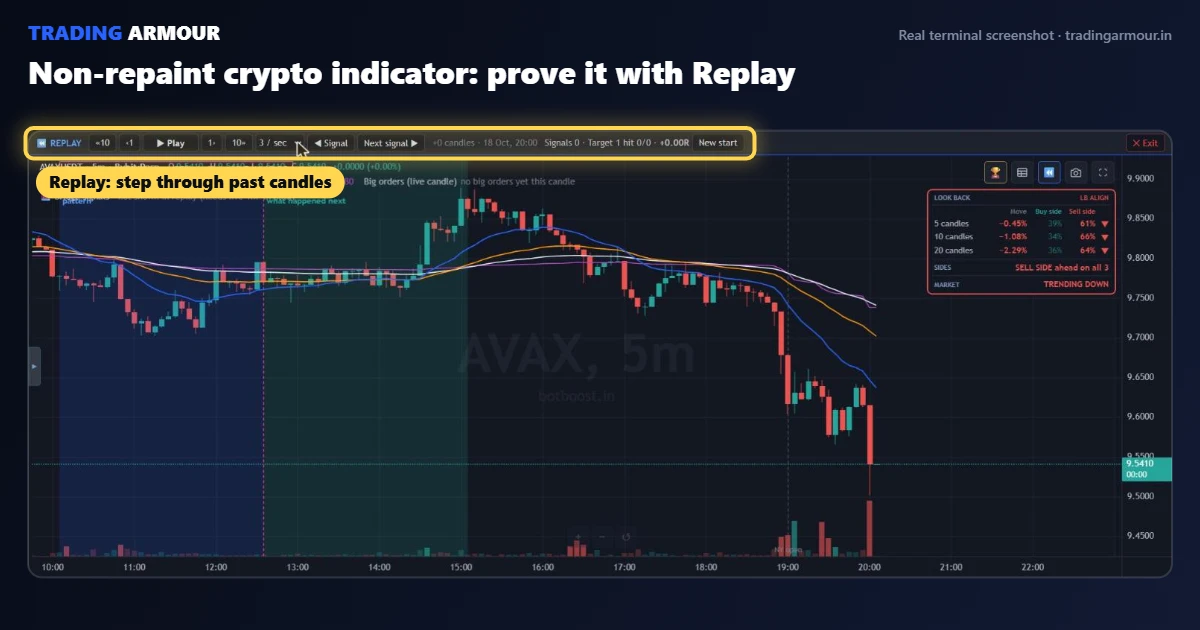
Next, use bar replay if your platform has it. Then play the chart forward one candle at a time. As a result, a tool that repaints will show arrows in replay that you never saw live. Finally, read the description. Words like “confirmed” or “on close” are good signs, but the screenshot test is the proof.
Trading Armour draws the entry, stop loss and two take profit targets on every signal. Also, it runs in your browser for Bybit and Binance futures.
Closed-candle signals in Trading Armour
Trading Armour is a non repaint crypto indicator by design. In other words, it only calculates a BUY or SELL after the candle has closed. So once a signal prints, it stays on the chart for good.
Each signal also arrives with its full plan: the entry, a stop loss and two take profit targets. Because the plan never changes after the close, the signal track record replays the same stop and targets you saw live.
Also, you can check this yourself with bar replay. Rewind any chart, play it forward, and the arrows appear exactly where they appeared in real time.
What non repaint does not promise
No repaint means honest history. Still, it does not mean every signal wins. Many trades will still hit their stop, so risk control matters just as much.
In addition, a closed-candle signal arrives a little later than a live-candle guess. That small delay is the price of honesty. For most traders it is worth it, because a late real signal beats an early fake one.
To keep losses small, read our guides on crypto scalping risk management and how to avoid stop loss hunting.
Non repaint crypto indicator checklist
- Signals appear only after the candle closes.
- Past arrows never move in a 30-minute screenshot test.
- Bar replay shows the same arrows you saw live.
- Every signal comes with a stop loss, not just an arrow.
- The seller explains the method in plain words, without profit promises.
If a tool passes all five checks, its backtest is at least honest. Then you can judge it on its real results. For more background, see this overview of technical analysis.
Non repaint crypto indicator FAQ
Does Trading Armour repaint?
No. Trading Armour calculates signals only on closed candles. Once a BUY or SELL prints, it never moves or disappears, so the history on your chart is what you could have traded live.
Is a non repaint crypto indicator always profitable?
No. It only means the signals are honest. Many trades will still lose, so you need a stop loss on every trade and a small, fixed risk per trade.
How long does a repaint test take?
About 30 minutes. Screenshot the last 20 candles, wait half an hour, and compare. Any arrow that moved or vanished means the tool repaints.
- Crypto buy sell signalsWhat a full signal looks like, so you know the entry, stop and two targets first.
- Best timeframe for scalping1, 3, 5 or 15 minutes? Pick the chart that fits your style, then pair it.
- Scalping risk managementSeven plain rules, because risk control keeps a scalping account alive.
- TradingView alternative for scalpingWhen an all-in-one terminal fits better than a charting site, and when it does not.