Crypto liquidation levels: where leveraged traders get forced out
Crypto liquidation levels are prices where leveraged traders get forced out of their positions. When price reaches them, the exchange closes those trades with market orders.
This guide explains why those zones attract price and how to read them on a chart. Then it shows how to keep your own stop away from the crowd.
- Crypto liquidation levels mark prices where leveraged positions get closed by force.
- Forced orders add fuel, so price often moves quickly through those zones.
- The terminal warns you when a cluster sits within 0.6% of your entry.
- Therefore, keep your stop clear of clusters and use low leverage.
How liquidation works
When you trade futures with leverage, you borrow to hold a bigger position. So if price moves against you far enough, your margin runs out.
So at that point, the exchange closes the position for you. In other words, it sells a long or buys back a short at market price. In short, that forced order is a liquidation.
Also, with high leverage the liquidation price sits very close to the entry. For example, at 50x, a move of about 2% can be enough. That is why so many traders get wiped out on small wicks.
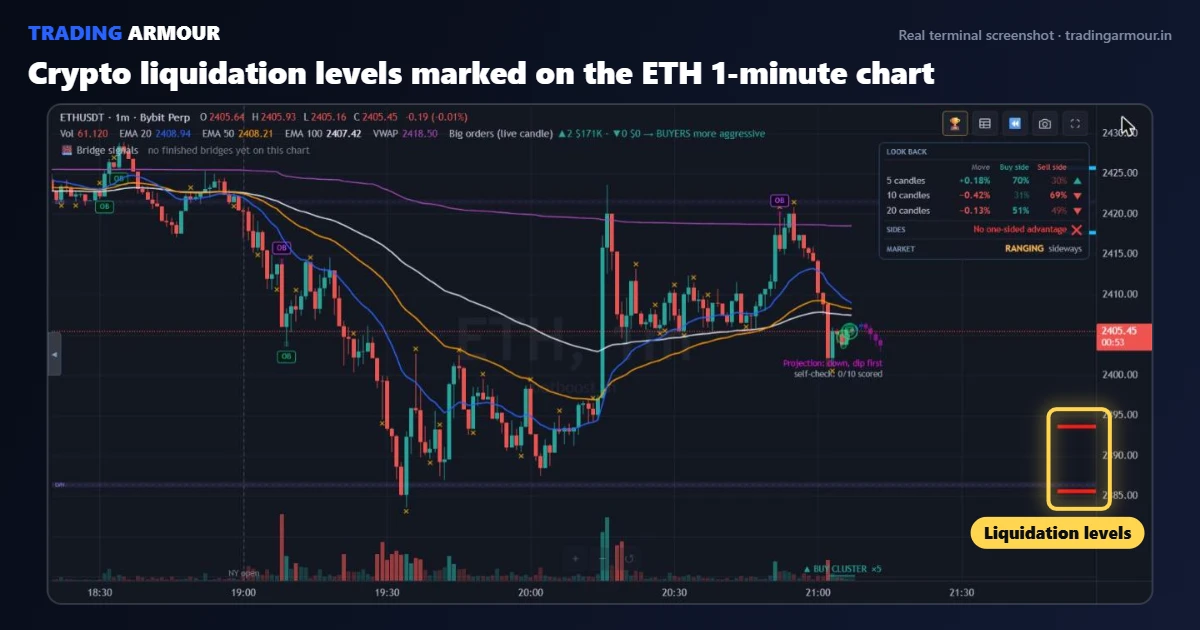
Why price is drawn to crypto liquidation levels
Usually, many traders open at similar prices with similar leverage. As a result, their liquidation prices bunch together into clusters.
When price reaches a cluster, the forced orders hit the market all at once. So a small move turns into a fast spike. Then, once the cluster is cleared, price often slows down or turns.
Of course, large traders know this. Therefore, they sometimes push price toward a big cluster, because the forced orders give them liquidity. In fact, our guide to stop loss hunting explains the same idea for stops.
Reading liquidation clusters on the chart
Trading Armour draws two tools for this:
- Liquidation Clusters: bands where many estimated liquidations sit.
- Liquidation Zone Arrows: markers that point to the strongest nearby zones.
Also, before a trade, the terminal checks the space around your entry. So if a strong cluster sits within 0.6% of it, you get a warning to expect wicks and slippage. So you can widen the stop, cut the size, or skip the trade.
Trading Armour draws the entry, stop loss and two take profit targets on every signal. Also, it runs in your browser for Bybit and Binance futures.
Trading around crypto liquidation levels
- Mark the nearest strong clusters above and below price.
- Then avoid placing your stop inside a cluster, because the spike will reach it.
- Instead, put the stop beyond the cluster, and reduce the size to match.
- Watch for a fast sweep into a cluster, followed by heavy orders that fail to push further.
- Finally, wait for a closed-candle signal before you enter the turn.
That last pattern often looks like absorption. For details, our absorption trading guide shows how to read it.
Protect yourself from liquidation
First of all, the simplest fix is low leverage. With 3x to 5x, your liquidation price sits far away, so your stop decides the exit instead of the exchange.
In addition, use isolated margin. Then one trade can only lose its own margin. The Binance stop loss bot guide shows how the trade panel sets this up.
Finally, remember that liquidation data is an estimate. Therefore, treat clusters as zones of risk, not exact prices.
Crypto liquidation levels and Bitcoin
Bitcoin has the largest clusters, so its sweeps often move the whole market. For example, when BTC runs into a big cluster, altcoins usually spike in the same direction.
So before you trade an altcoin, check the crypto liquidation levels on Bitcoin too. If BTC sits close to a large cluster, expect a fast move soon. In that case, wait until the sweep is over, and then trade the reaction.
Crypto liquidation levels questions
Are liquidation levels exact?
No. They are estimates based on where positions were likely opened and with what leverage. Treat them as zones, not precise prices.
Why does price spike through liquidation zones?
Because forced orders hit the market all at once. That extra flow turns a small move into a fast spike, and price often slows once the zone clears.
How do I avoid being liquidated?
Use low leverage, isolated margin and a real stop loss. Then your stop closes the trade long before the exchange has to.
- Stop loss hunting in cryptoWhy your stop gets hit before price turns, and where to place it instead.
- Crypto order flow indicatorRead big orders, delta and the order book, so you see who is pushing price.
- Absorption trading in cryptoWhen big orders hit but price refuses to move, someone is absorbing them.
- Binance stop loss botPut a real stop on every Binance futures trade, plus a daily loss limit.