Crypto position size calculator for futures traders
A crypto position size calculator tells you how big a trade should be. First, you enter your account size, your risk and your stop. Then it gives you the exact size.
So every loss costs the amount you chose, no matter how wide the stop is. Use the free calculator below, and then read how to set each input.
- Position size comes from your risk and your stop distance, not from leverage.
- Risk a small, fixed amount, such as 0.5% to 1% of the account.
- A wider stop simply needs a smaller position, so the dollar risk stays the same.
- Also, the calculator runs in your browser and saves nothing.
Free crypto position size calculator
Example values. Type your own trade.
Enter your numbers, and then copy the size into your order. If the stop changes, run it again, because a new stop means a new size.
How the crypto position size calculator works
Luckily, the maths is simple, so you can check it by hand. First, the calculator finds your risk in dollars. For example, 1% of a $1,000 account is $10.
Then it measures the stop distance. For example, if you buy at 100 and your stop is at 98, the distance is 2, or 2%.
Finally, it divides the dollar risk by the stop distance. So $10 divided by 2% gives a position of $500. So if the stop hits, you lose about $10, plus fees.
Why leverage does not change your risk
Many beginners think leverage sets their risk. In fact, the position size and the stop set it. Instead, leverage only decides how much margin the exchange holds.
For instance, a $500 position at 5x needs $100 of margin. Meanwhile, at 10x it needs $50. However, in both cases the loss at the stop is the same $10.
However, high leverage moves your liquidation price closer. So keep leverage low, and let the stop close the trade. Also, read more about leverage if this is new to you.
Trading Armour draws the entry, stop loss and two take profit targets on every signal. Also, it runs in your browser for Bybit and Binance futures.
Choosing risk in a crypto position size calculator
| Account | Risk 0.5% | Risk 1% |
|---|---|---|
| $500 | $2.50 | $5 |
| $2,000 | $10 | $20 |
| $10,000 | $50 | $100 |
| $25,000 prop | $125 | $250 |
In general, most traders do well between 0.5% and 1%. Then even ten losses in a row leave most of the account intact. On a prop firm account, the lower end is safer, because daily limits are strict. Our crypto prop firm challenge guide explains why, so read it before an evaluation.
Common sizing mistakes
- Sizing by feel: big on confident trades, small on others. Instead, keep risk fixed.
- Tight stops to keep size big: they get swept. Rather, widen the stop and cut the size.
- Forgetting fees: on small targets, fees can eat a big share. So include them.
- Adding to losers: it raises risk after you were wrong.
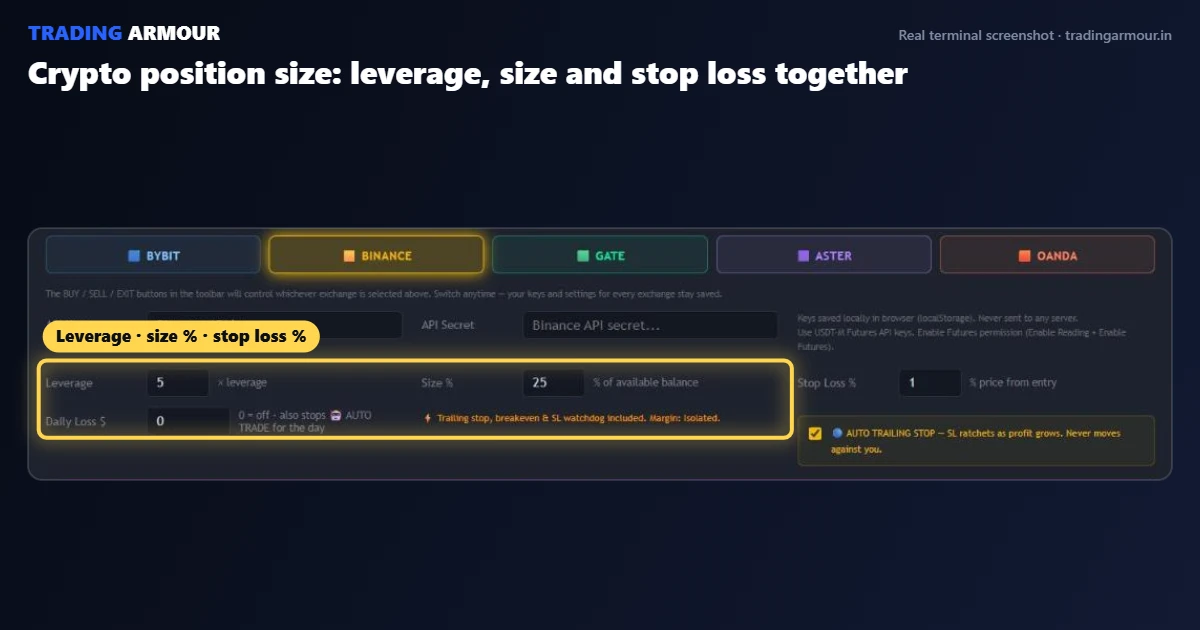
Also, the Trading Armour trade panel does this sizing for you from each signal stop. Meanwhile, this crypto position size calculator is useful when you trade by hand or on a prop firm platform.
A worked example
Say your account is $2,000 and you risk 1%, so $20. A SELL prints on ETH at 2,500, with the stop at 2,525. Therefore, the stop distance is 25, or 1%.
Then $20 divided by 1% gives a $2,000 position, which is 0.8 ETH. At 5x leverage, that uses $400 of margin. So if the stop hits, you lose about $20. On the other hand, if Target 1 hits at 2,475, half the trade banks about $10, and the rest runs with the stop at entry.
Position size calculator FAQ
Does the calculator include fees?
It shows the size for your chosen risk at the stop. Fees come on top, so on very small targets lower the risk slightly to cover them.
Is my data saved?
No. The calculator runs in your own browser and does not send or store anything.
What risk per trade should I use?
Most traders use 0.5% to 1% of the account. On prop firm accounts, the lower end is usually safer.
- Scalping risk managementSeven plain rules, because risk control keeps a scalping account alive.
- Pass a crypto prop firm challengeA rule-first plan, because daily loss limits fail more accounts than bad entries.
- Binance stop loss botPut a real stop on every Binance futures trade, plus a daily loss limit.
- Stop loss hunting in cryptoWhy your stop gets hit before price turns, and where to place it instead.