Similar chart patterns in crypto: what happened last time?
Similar chart patterns answer a simple question: the last times the chart looked like this, what happened next? So instead of guessing, you look at evidence.
This guide explains how pattern matching works and how to read the results. It also shows why a match is a clue, not a promise.
- Similar chart patterns show what price did after past moments that looked like now.
- History match checks the same coin, while SIMILAR checks other coins.
- Read the count, the direction and the average move together.
- However, a match is a clue, so keep the stop and the size rules.
Why similar chart patterns help
Markets repeat behaviour, even if they never repeat exactly. That is why traders study the past before they risk money. For example, a sharp drop into support followed by a slow grind often leads to a bounce. Yet sometimes it leads to another leg down.
However, pattern matching counts both outcomes. So you see how often each one happened, rather than remembering only the dramatic ones.
Two ways to find similar chart patterns
Trading Armour gives you two tools for this:
- History match: looks back through the current coin’s own history and counts how many similar moments went up next, with the average move.
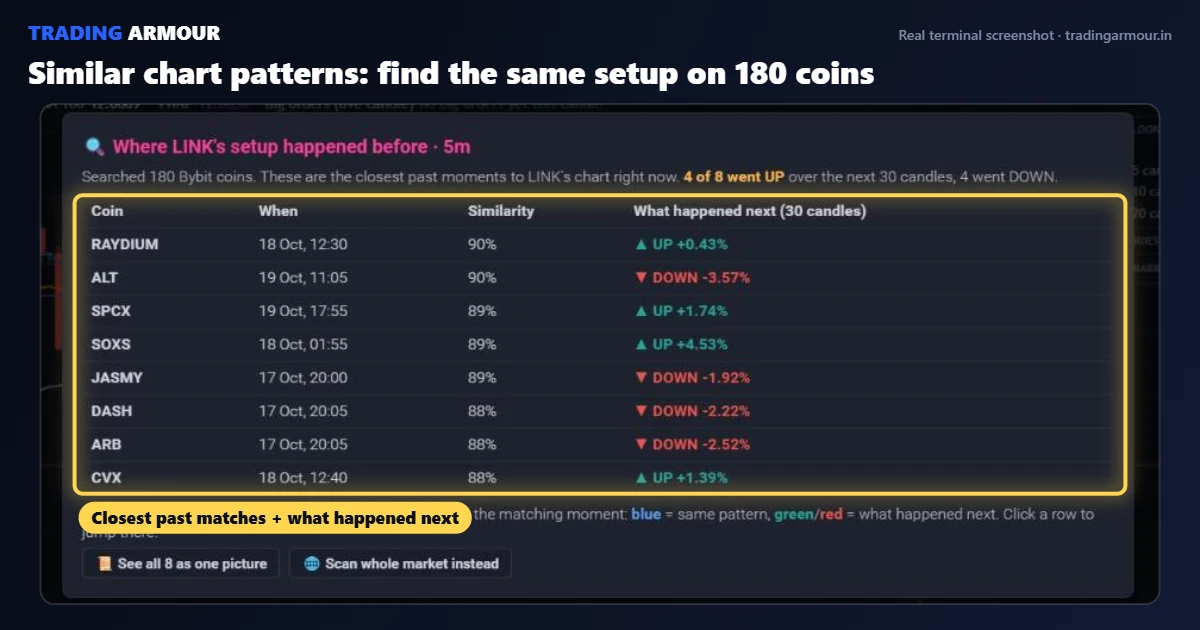
- SIMILAR: looks for the current setup on other coins. Then it shows what happened next on each one, with a chart you can download.
The first tells you how this coin tends to behave. Meanwhile, the second tells you how the wider market reacted to the same shape.
How to read a match
For example, say History match shows “14 of 20 similar past moments went up next”. That is 70%, which sounds strong. However, also check the size of the move. After all, a small average gain with big losers is not a great setup.
So read three numbers together:
- Count: how many matches there were. Under ten is a thin sample.
- Direction: how many went up versus down.
- Average move: how far price went, on average, after the match.
Then compare with the live signal. When the match, the signal and the AI verdict all agree, the setup has more support. By contrast, when they disagree, the safest choice is usually to wait.
Trading Armour draws the entry, stop loss and two take profit targets on every signal. Also, it runs in your browser for Bybit and Binance futures.
Similar chart patterns on other coins
Meanwhile, the SIMILAR button scans other coins for the same shape. This is useful when your coin has little history, for example a new listing.
In addition, if the same setup worked on several large coins this week, the market may be in a mood that favours it. On the other hand, if it failed everywhere, caution makes sense.
Finally, the Similar Setups scanner goes one step further. It keeps looking across coins and logs every strong match, so you can review them later.
Mistakes to avoid
- Trusting a tiny sample. Five matches can easily be luck.
- Ignoring the trend. A bullish match in a falling market often fails.
- Skipping the stop. Even a strong match needs a stop loss.
- Chasing. If price already moved toward the target, the edge is smaller.
So use the match to filter trades, never to justify a trade you already wanted.
Where pattern matching fits
In general, pattern matching sits between technical analysis and statistics. Therefore, it works best alongside signals, order flow and risk rules.
For instance, start with a fresh signal from the AI crypto signal scanner. Then check the history match. Finally, size the trade with the position size calculator. Also, you can see the SIMILAR tool on the features page.
Similar chart patterns FAQ
Where does the pattern data come from?
From the coin’s own candle history on the exchange, and from other coins for the SIMILAR scan. Nothing is guessed; the tool counts what actually happened next.
How many matches do I need to trust the result?
More is better. Under ten matches is a thin sample, so treat it as a weak hint rather than evidence.
Does a strong match mean the trade will win?
No. It means similar moments went that way more often in the past. You still need a stop loss and a small, fixed risk.
- AI crypto signal scannerLet a scanner watch 120 coins, so an alarm rings when a setup appears.
- Fair value gap scannerFind open gaps of 1% or more on top movers, then wait for the retest.
- AI crypto trading agentsHow 20+ AI agents vote, and why one plain verdict beats twenty opinions.
- Crypto buy sell signalsWhat a full signal looks like, so you know the entry, stop and two targets first.