Stop loss hunting in crypto: why it happens and how to avoid it
Stop loss hunting is the feeling that the market saw your stop. Price dips, hits it by a few ticks, and then flies in your direction.
Nobody is watching your personal stop. Still, the pattern is real. This guide explains why it happens and how to place stops where sweeps reach them less often.
- Stop loss hunting happens because big traders need liquidity, so it is not personal.
- Stops cluster below obvious lows, at round numbers and at range edges.
- Instead of tightening the stop, place it beyond the wick and then reduce the size.
- Also, a finished sweep followed by absorption can become a setup.
Why stop loss hunting happens
Large traders need someone to trade with. For example, a big buyer needs many sellers at once. Yet sellers are scattered, so the buyer looks for a place where many sell orders sit together.
Stops below an obvious low are exactly that place. When price dips there, the stops turn into market sells. As a result, the big buyer fills a large order at a good price. Then price often snaps back up.
So the hunt is not personal. Instead, it is the market looking for liquidity.
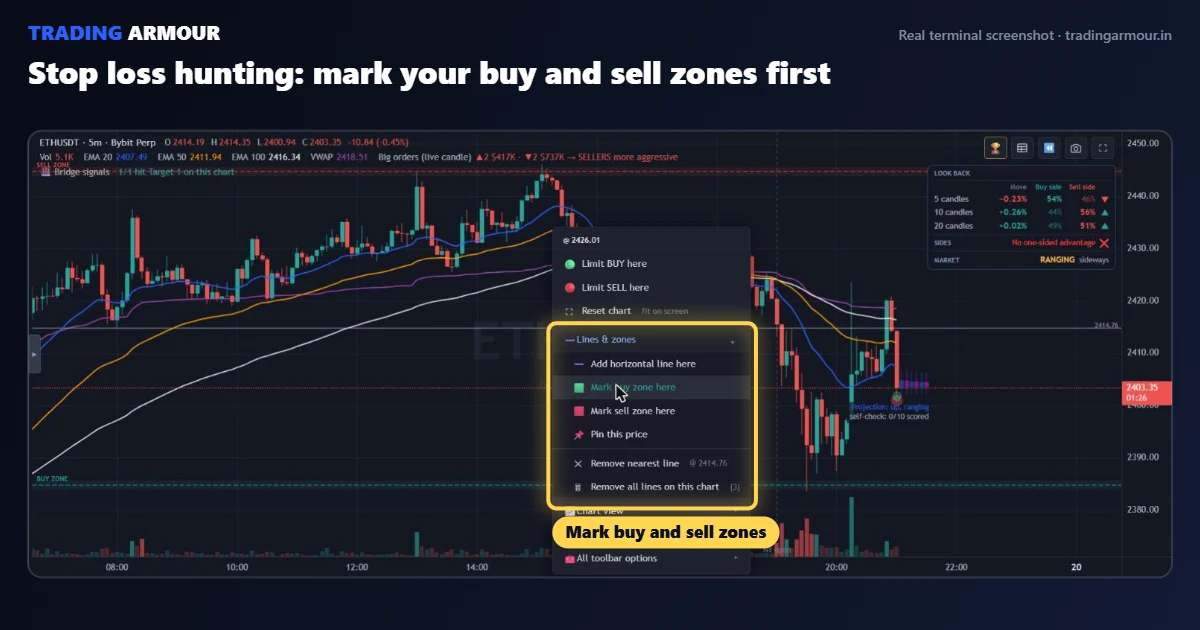
Where stops cluster
- Just below obvious swing lows and above swing highs.
- At round numbers, such as 100.00 or 2,500.
- Below the low of the last big candle.
- At the edges of tight ranges.
- Near liquidation levels of crowded leveraged trades.
If your stop sits in any of these places, it sits with everyone else. Therefore, it is more likely to be swept.
Five ways to avoid stop loss hunting
- Place the stop beyond the wick, not the body. Give the level a small buffer, such as a fraction of the recent average range.
- Avoid round numbers. Put the stop a little past them instead of on them.
- Skip choppy ranges. In a tight range, both edges get swept again and again.
- Trade busy hours. At night, thin books make wicks larger.
- Size from the stop. A wider, safer stop needs a smaller position, so the dollar risk stays the same.
The last point is the key. Many traders tighten the stop to keep the size big. However, that only puts the stop where the sweep will reach it.
Trading Armour draws the entry, stop loss and two take profit targets on every signal. Also, it runs in your browser for Bybit and Binance futures.
Use the stop hunt as a setup
Once you understand stop loss hunting, you can trade with it rather than against it. Wait for price to sweep a clear low. Then watch for heavy selling that fails to push price lower.
That is absorption. When the candle closes back above the low and a BUY prints, the sweep may be over. Our absorption trading guide shows the full setup.
In this case, the stop goes below the sweep wick. Because the hunt already happened there, the level is cleaner.
How Trading Armour helps
Trading Armour places each signal stop beyond the recent swing, rather than at the obvious low. In addition, the terminal warns when a liquidation cluster sits close to your entry, because wicks are more likely there.
Also, the crypto order flow indicator shows big orders as they hit. So you can see a sweep and the reaction in real time.
Stop loss hunting on prop firm accounts
Prop traders feel stop hunts more, because daily limits leave little room. So a safer stop with a smaller size is even more important there.
Our guide to the crypto prop firm challenge covers daily rules. Meanwhile, you can read the theory behind order types and how stops become market orders.
Stop loss hunting questions
Are exchanges hunting my personal stop?
Very unlikely. Price moves to where many orders sit together, such as below obvious lows. If your stop is there, it gets swept with everyone else’s.
Should I trade without a stop to avoid hunts?
No. Without a stop, one bad move can wipe out the account. Instead, place the stop beyond the wick with a buffer, and reduce the size.
How wide should my stop be?
Wide enough to sit beyond normal wicks for the coin and timeframe. Then size the position so the dollar risk stays small.
- Absorption trading in cryptoWhen big orders hit but price refuses to move, someone is absorbing them.
- Crypto liquidation levelsWhere leveraged traders get forced out, and why price is drawn there.
- Position size calculatorFree calculator: turn your risk and stop into an exact size, so losses stay fixed.
- Bybit trailing stop botLet the stop follow price, so profit stays locked in as the trade runs.