Fair value gap scanner: find open FVGs on the biggest movers
A fair value gap scanner finds price gaps that the market has not filled yet. So instead of hunting through charts, you get a short list of levels to watch.
This guide explains what a fair value gap is, why price often comes back to it, and how to trade the retest with a safe stop.
- A fair value gap is a fast move that leaves a hole between three candles.
- Price often returns to fill part of the gap, so the edge becomes a level to watch.
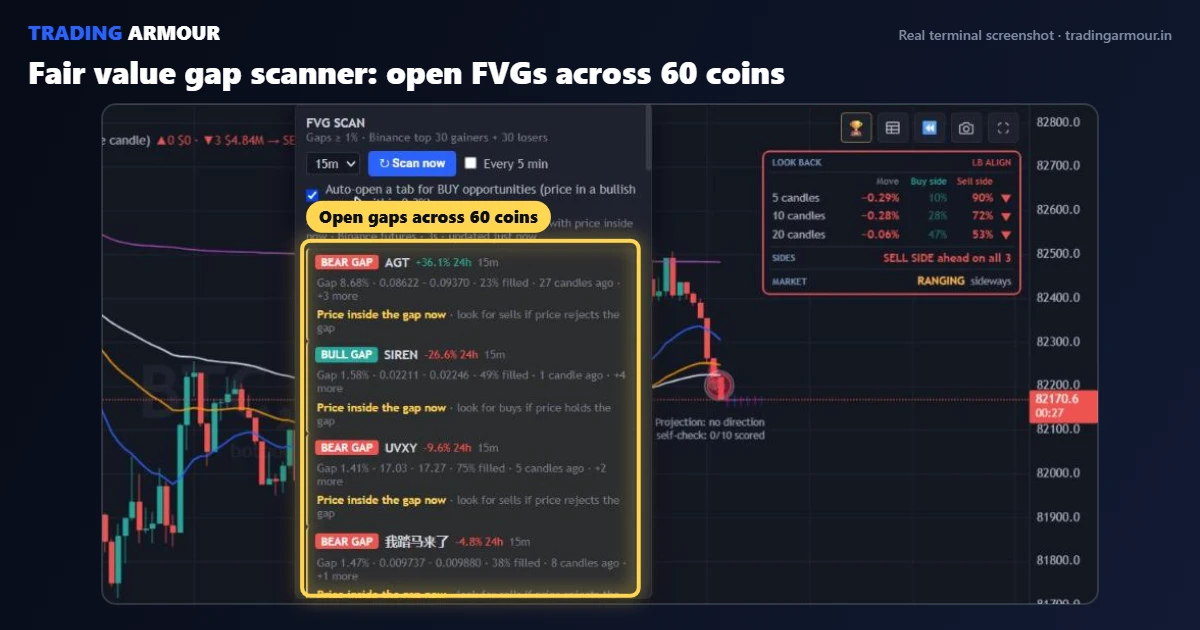
- FVG SCAN finds open gaps of 1% or more on the top 30 gainers and top 30 losers.
- However, never enter on the gap alone; wait for a closed-candle signal.
What a fair value gap is
A fair value gap, or FVG, forms when price moves so fast that it leaves a hole. Look at three candles in a row. If the first candle’s high is below the third candle’s low, the space between them is a bullish gap.
In other words, price jumped through that zone with almost no trading. As a result, few orders were filled there. Later, price often returns to that zone, because the market tends to test levels it skipped.
The same works in reverse for bearish gaps. So a sharp drop leaves a gap above, and price may revisit it before falling again.
Why use a fair value gap scanner
Gaps appear on every coin and every timeframe. However, most of them are tiny and meaningless. Therefore, you need a filter.
The Trading Armour FVG SCAN keeps only gaps of 1% or more. Also, it checks only the top 30 gainers and top 30 losers of the last 24 hours on Binance futures. Those coins move the most, so their gaps are the clearest.
- You choose the timeframe the scan checks.
- Each result shows the coin, the gap zone and its direction.
- Then one click opens the chart with the gap drawn.
How to trade a fair value gap retest
- Pick a gap that points with the trend of the higher timeframe.
- Next, wait for price to return into the gap zone.
- Then watch the candles inside the gap. You want rejection, such as long wicks or absorption.
- Enter only when a closed-candle signal agrees with the gap direction.
- Finally, place the stop beyond the far edge of the gap.
Because the far edge is the line in the sand, a close beyond it means the gap failed. So the stop sits there, and the size comes from that distance.
Trading Armour draws the entry, stop loss and two take profit targets on every signal. Also, it runs in your browser for Bybit and Binance futures.
When gaps fail
Not every gap holds. In fact, strong trends often slice straight through old gaps. So be careful in three cases:
- The gap points against the 1 hour trend.
- Price returns with huge momentum and no slowdown.
- Moreover, the gap has already been tested twice.
In those cases, skip it. After all, the scanner will find new gaps every day, so there is no reason to force one.
Fair value gap scanner plus other tools
A gap tells you where to look. Meanwhile, other tools tell you when to act. For example, big order bubbles inside the gap show whether buyers are defending it. Our absorption trading guide explains that pattern.
Also, the similar chart patterns tool shows how often gaps like this held on the same coin. Then size the trade with the position size calculator.
For background, gaps are a form of technical analysis, so they work best with clear rules and a stop.
Fair value gap scanner FAQ
Which coins does FVG SCAN check?
The top 30 gainers and the top 30 losers of the last 24 hours on Binance futures. Those coins move most, so their gaps are the clearest.
What size of gap does the scanner show?
Only open gaps of 1% or more. Smaller gaps are usually noise on fast coins.
Do I enter as soon as price touches the gap?
No. Wait for rejection inside the gap and a closed-candle signal. Then place the stop beyond the far edge of the gap.
- AI crypto signal scannerLet a scanner watch 120 coins, so an alarm rings when a setup appears.
- Similar chart patternsFind where today’s setup happened before, and then see what price did next.
- Absorption trading in cryptoWhen big orders hit but price refuses to move, someone is absorbing them.
- Best timeframe for scalping1, 3, 5 or 15 minutes? Pick the chart that fits your style, then pair it.